-
- APC Back UPS
- APC EASY UPS
- APC Modular UPS
- APC Smart SMC UPS
- APC Smart SMT UPS
- APC Smart SURT UPS
- APC SPM UPS
- APC Symmetra Power Module
- APC SYMMETRA LX
- APC Symmetra PX
- Eaton 5P UPS
- Eaton 5PX G2 UPS
- Eaton 93PR UPS
- Eaton 9PX Li-Ion UPS
- Eaton 9PX UPS
- Eaton 9SX Tower UPS
- Eaton DX RT UPS
- Eaton DX UPS
- Eaton Ellipse ECO UPS
- Eaton Marine UPS
- Eaton Power Module
- SANTAK UPS
- Schneider Galaxy 3L / EASY 3L UPS
- Schneider Galaxy VS UPS
- Schneider Galaxy VL UPS
- Vertiv UPS


Three types of UPS and their output waveforms ( Part 2)

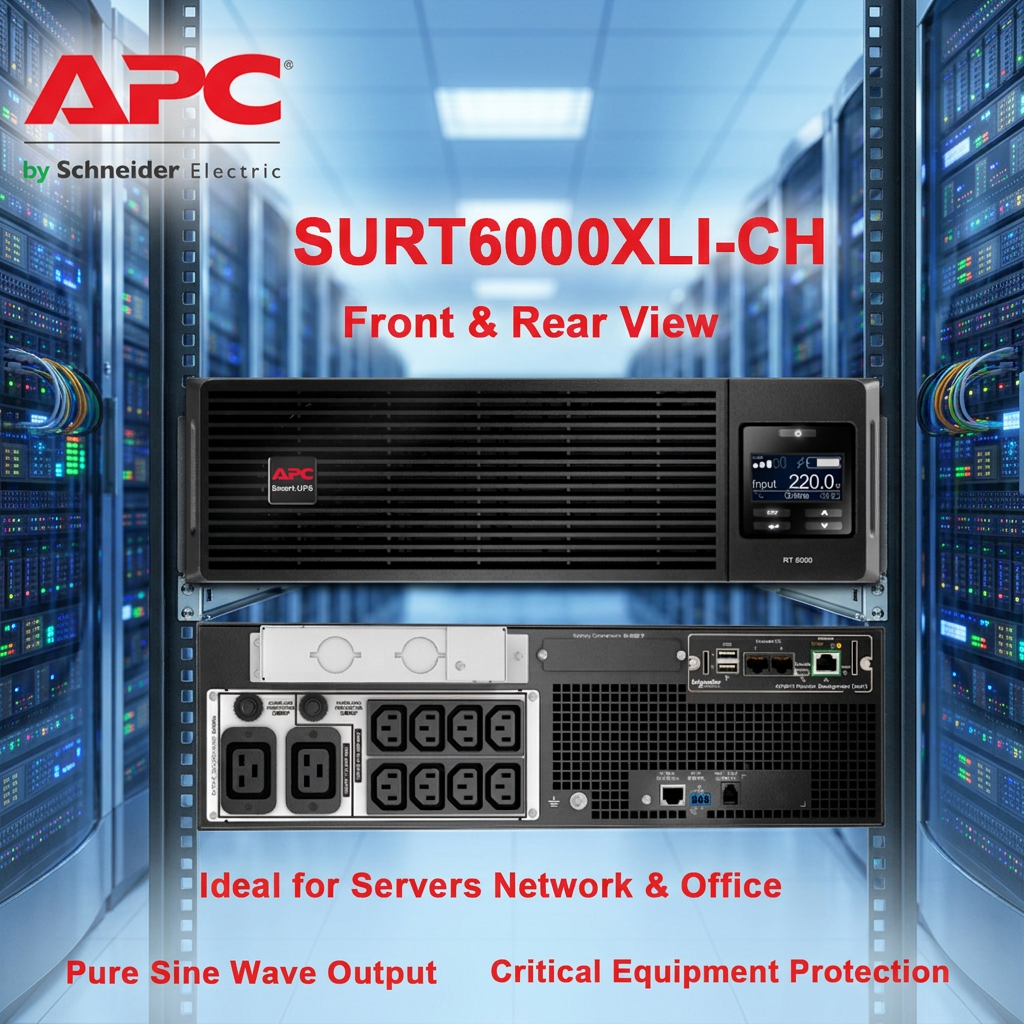
The positioning of online interactive systems is clear: server racks, monitoring systems, and network switching rooms for small and medium-sized enterprises. It’s more reliable than standby systems and significantly cheaper than online systems. If your company only has two or three servers and a limited budget, online interactive systems offer good value for money.
Online UPS : Professional-grade protection, pure waveform.
Online UPS systems are truly high-end products. They use a technology called ” double conversion “: the incoming AC power is first converted to DC, and then an inverter regenerates the AC output. Regardless of external voltage fluctuations, frequency drifts, or interference spikes , the load always uses the newly generated power from the inverter.
Moreover, it has zero switching. The battery connects immediately during a power outage, and the load is imperceptible.
Online UPS outputs a pure sine wave . What is a pure sine wave? It’s exactly the same waveform as the electrical waveform coming from your wall socket, and even cleaner than the waveform of the power grid in many older residential areas.
With a pure sine wave, you no longer need to be picky about the load. Whether it’s an air conditioner compressor , a hospital CT scanner, an audio amplifier, or an industrial PLC , it will run as usual without any extra heat or buzzing noise.
I maintain a small data center that uses online UPS systems with external battery packs. Once, the mains power flickered for a second, but the equipment was completely unaffected; even the switch logs didn’t record any anomalies. With a standby UPS, those few milliseconds of switching would have been enough to reboot the core switch.
Of course, online systems also have drawbacks: they are expensive and consume about 5%-8% of the electricity themselves. However, for scenarios where power outages are unavoidable, this cost is necessary.
Three real-life examples to tell you how to choose
Last year, a friend of mine opened a print shop and bought a backup UPS to connect to a laser printer. Every time the printer started, the UPS would alarm, and eventually, the UPS burned out. I told him that laser printers have internal heating rollers , which draw a large instantaneous starting current and are inductive loads , so an online pure sine wave printer must be used. After he replaced it, he never had any more problems.
Another customer was a home theater system owner with imported Hi-Fi amplifiers. He was using a very cheap online interactive UPS, and he always felt there was a “buzzing” background noise in his speakers, which he couldn’t solve even after trying several different power strips. Later, I had him replace it with an online pure sine wave UPS, and the background noise immediately disappeared. Amplifiers are extremely sensitive to power quality; high-frequency harmonics in an analog sine wave can directly interfere with the audio signal .
The most typical example of what not to do is a small factory owner who, in an effort to save money, connected a frequency converter on the production line to a standby UPS. Less than a week later, the frequency converter malfunctioned, and repairs cost over three thousand yuan. The standby UPS, on the other hand, only cost five hundred yuan. A classic case of penny-wise and pound-foolish.