-
- APC Back UPS
- APC EASY UPS
- APC Modular UPS
- APC Smart SMC UPS
- APC Smart SMT UPS
- APC Smart SURT UPS
- APC SPM UPS
- APC Symmetra Power Module
- APC SYMMETRA LX
- APC Symmetra PX
- Eaton 5P UPS
- Eaton 5PX G2 UPS
- Eaton 93PR UPS
- Eaton 9PX Li-Ion UPS
- Eaton 9PX UPS
- Eaton 9SX Tower UPS
- Eaton DX RT UPS
- Eaton DX UPS
- Eaton Ellipse ECO UPS
- Eaton Marine UPS
- Eaton Power Module
- SANTAK UPS
- Schneider Galaxy 3L / EASY 3L UPS
- Schneider Galaxy VS UPS
- Schneider Galaxy VL UPS
- Vertiv UPS



What are the main parameters of a UPS (Uninterruptible Power Supply)? ( Part 1)

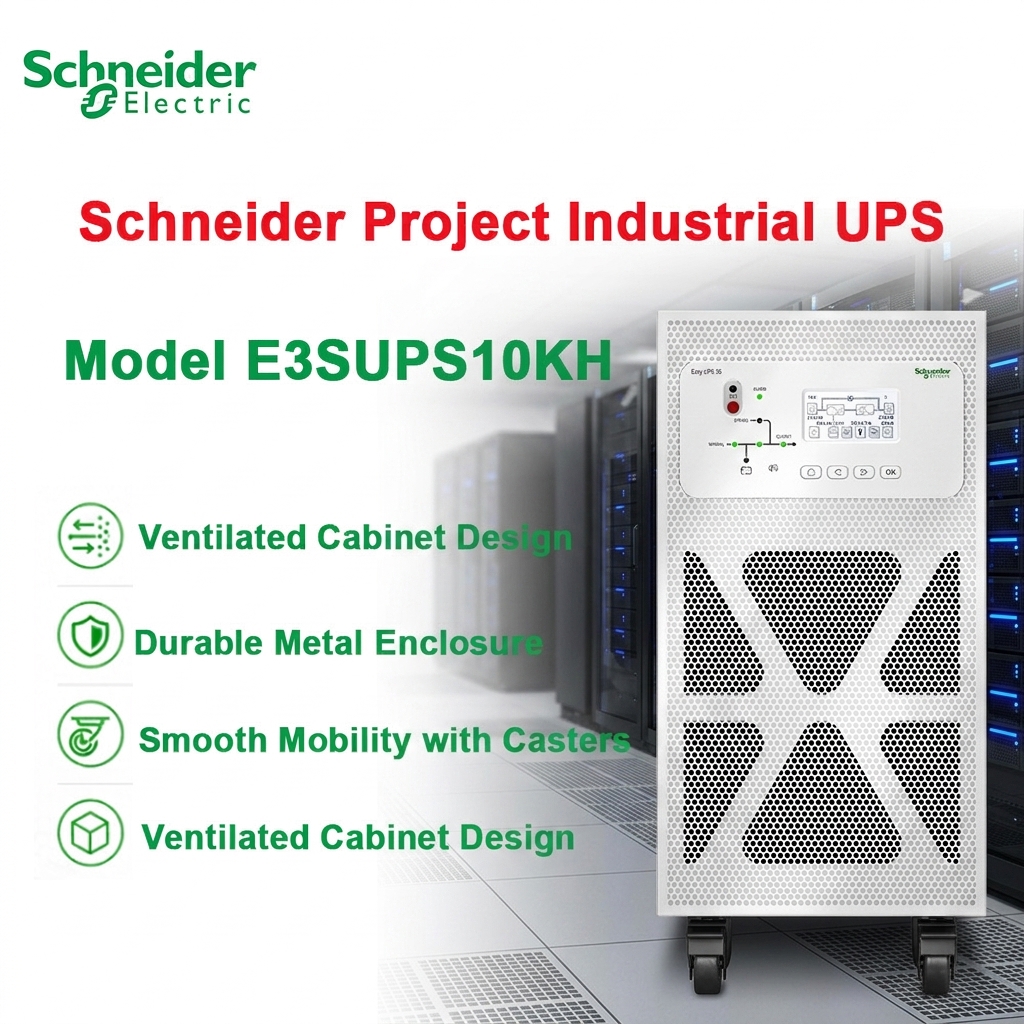
In data center server rooms, hospitals, and banks, you may have seen this “computer case-like” device – a UPS (Uninterruptible Power Supply).
In reality, it acts as a “power guardian” for networks and devices. It will step in immediately if there’s a problem with the mains power, ensuring your devices experience orderly power outages and operate smoothly.
However, when it comes to UPS selection and parameters, many people’s first reaction is:
“Ah… the higher the power, the better, right? As long as it’s stable, that’s fine.”
In reality, the parameters of a UPS are far more complex than you might imagine—power is just the tip of the iceberg. Choosing the wrong one could not only waste money but also create risks.
First, let’s quickly clarify the concept: UPS (Uninterruptible Power Supply) is a device that can provide continuous power when the mains power is abnormal or interrupted, and it can also play a role in voltage stabilization, filtering, and surge protection.
It primarily addresses two pain points:
1. Power outage risk: Sudden power outages to servers, switches, and databases may result in data loss and hard drive damage.
2. Electrical quality issues: Voltage fluctuations, momentary drops, surges, harmonics, and other problems can shorten the lifespan of equipment.
A UPS is like your “power insurance,” saving your life in critical moments.
UPS Main Parameters Overview
Buying a UPS is not a blind choice; here are some common and essential parameters to consider:
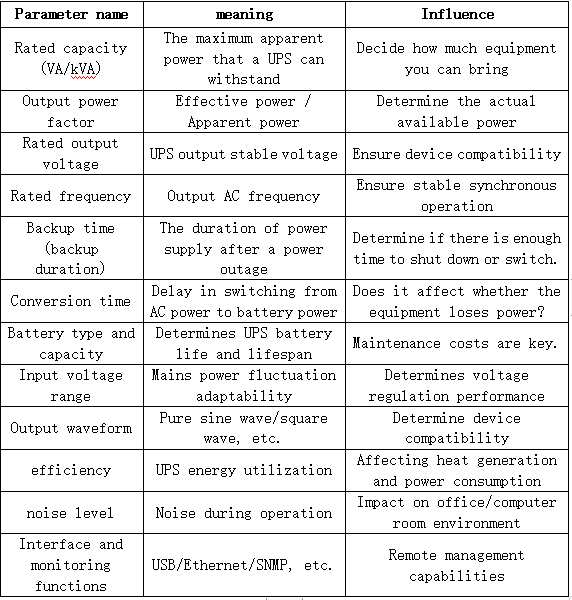
Next, let’s break them down one by one.
Rated capacity (VA/kVA)
The capacity unit of a UPS is usually VA (volt-ampere) or kVA (kilovolt-ampere), which represents apparent power and not all of it is available.
Why not just use watt (W) directly?
Because UPS outputs AC power, power = voltage × current × power factor. Since the power factor is usually not 1, manufacturers use VA as a standard designation.
Selection method:
• First calculate the total power of the equipment (W).
• Divide by the UPS power factor (e.g., 0.8).
• Multiply by 1.2 to 1.3 (for redundancy)
Assuming your server and network equipment have a total power consumption of 800W and a UPS power factor of 0.8:
800 ÷ 0.8 = 1000 VA
1000 × 1.2 = 1200 VA
Then you need to choose a UPS with a capacity of at least 1.2 kVA.
Output power factor (PF)
Power factor = Effective power (W) ÷ Apparent power (VA).
The higher the power factor of a UPS, the larger the actual load it can handle with the same VA.