-
- APC Back UPS
- APC EASY UPS
- APC Modular UPS
- APC Smart SMC UPS
- APC Smart SMT UPS
- APC Smart SURT UPS
- APC SPM UPS
- APC Symmetra Power Module
- APC SYMMETRA LX
- APC Symmetra PX
- Eaton 5P UPS
- Eaton 5PX G2 UPS
- Eaton 93PR UPS
- Eaton 9PX Li-Ion UPS
- Eaton 9PX UPS
- Eaton 9SX Tower UPS
- Eaton DX RT UPS
- Eaton DX UPS
- Eaton Ellipse ECO UPS
- Eaton Marine UPS
- Eaton Power Module
- SANTAK UPS
- Schneider Galaxy 3L / EASY 3L UPS
- Schneider Galaxy VS UPS
- Schneider Galaxy VL UPS
- Vertiv UPS


How are the performance and architecture of a UPS power supply evaluated? ( Part 1)

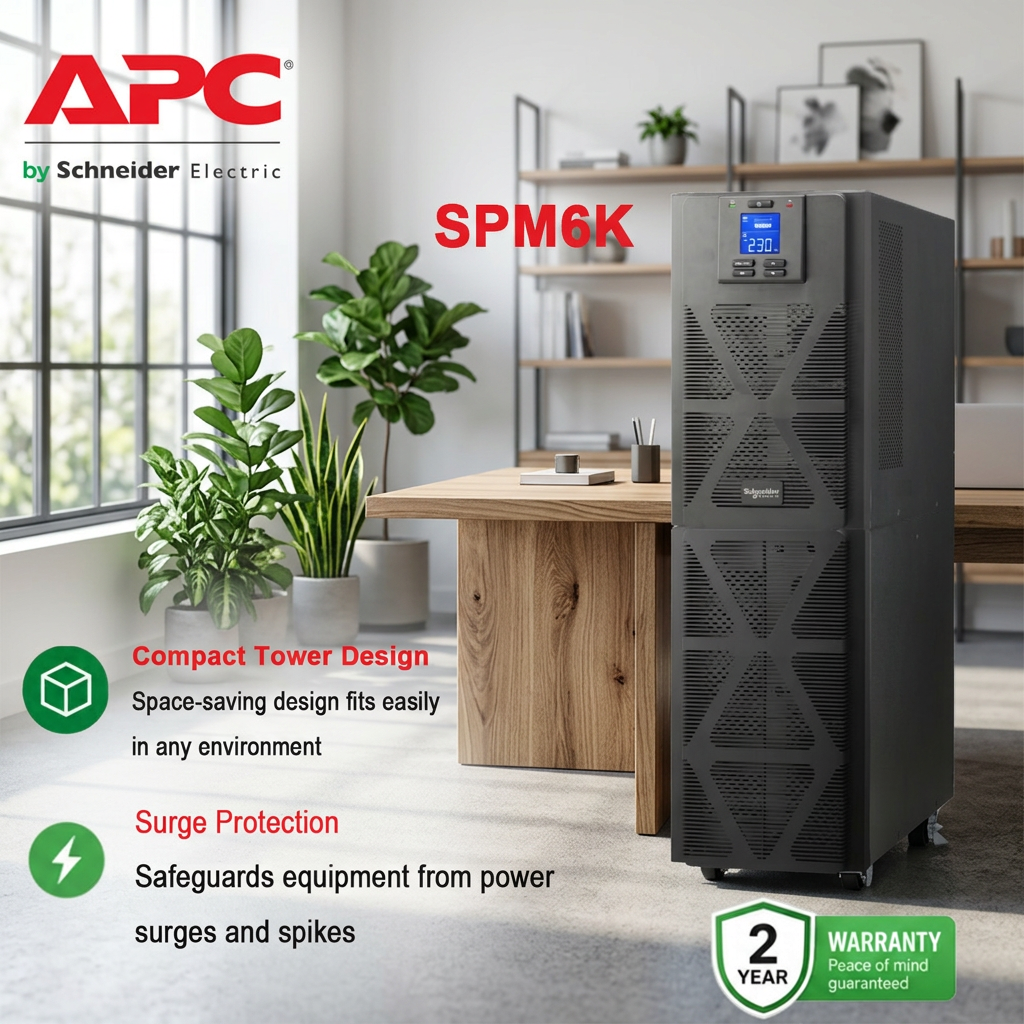
Many people choose UPS systems based solely on capacity and price, ignoring the underlying architecture and actual performance. This often results in system failures and repeated battery drain due to grid fluctuations. We can break this down into two parts: architecture evaluation and performance evaluation, explaining it in a straightforward and easy-to-understand manner.
I. Architecture Assessment: First, examine the underlying design logic
architecture, which is the power supply backbone of the UPS, determining its basic reliability, switching logic, expansion capabilities, and maintenance methods.
1. Basic topology architectures
are mainly divided into three categories, each with completely different applicable scenarios.
Standby (offline): When the mains power is normal, the inverter is directly powered by the mains and is in standby mode. It switches to battery power only when the power is lost, with a switching time typically ranging from a few milliseconds to tens of milliseconds. It has the simplest structure and lowest cost, but its voltage regulation and filtering capabilities are very poor. Many of them output corrected waveforms and can only be used in non-core devices such as home computers and routers. They are not suitable for computer rooms or precision instruments.
Online interactive type: With the addition of voltage regulation circuit and bidirectional inverter, it can stabilize the voltage slightly before the mains power is abnormal. The switching speed is faster than the backup type. It balances efficiency and basic voltage stabilization and is suitable for ordinary commercial scenarios such as small and medium-sized office and cash register equipment. However, it cannot completely isolate complex power grid interference such as harmonics and surges.
Double-conversion online UPS: The mains power is first rectified into DC power, then inverted into pure AC power for continuous output. The battery is directly connected to the DC bus. Seamless switching with almost zero switching time is possible in case of mains power failure. It isolates the entire process from dirty current interference and outputs a pure sine wave. This is the mainstream architecture for high-reliability scenarios such as data centers, medical equipment, and industrial production lines. It’s also important to distinguish between line-frequency and high-frequency models: Line-frequency models have line-frequency isolation transformers, offering strong resistance to shocks and interference, suitable for harsh industrial power grid environments; High-frequency models use high-frequency PFC rectification, resulting in smaller size and higher overall energy efficiency, suitable for conventional data center environments. Another option is a modular architecture, which breaks down the UPS into multiple independent power modules, supporting N+1 redundant parallel connection, online hot-swappable maintenance, and phased capacity expansion. This is commonly used in critical data centers, but the maturity of the parallel control technology must be confirmed to avoid uneven module parallel connection and mutual interference.
Additionally, redundant design should be considered: Does it include independent bypasses, maintenance bypasses, redundant control and power circuits, and can maintenance be performed without shutting down the system? Also, the battery management system (BMS) should be examined to ensure it can monitor the voltage, temperature, and internal resistance of each battery cell in real time, preventing overcharging, over-discharging, and premature aging.
2. The overall structure and operation and maintenance architecture
should also consider heat dissipation design, protection level, monitoring and communication capabilities (remote alarms, data monitoring), and compatibility with local power supply systems (single-phase/three-phase) and power distribution layout to facilitate future maintenance, inspection, and troubleshooting.