-
- APC Back UPS
- APC EASY UPS
- APC Modular UPS
- APC Smart SMC UPS
- APC Smart SMT UPS
- APC Smart SURT UPS
- APC SPM UPS
- APC Symmetra Power Module
- APC SYMMETRA LX
- APC Symmetra PX
- Eaton 5P UPS
- Eaton 5PX G2 UPS
- Eaton 93PR UPS
- Eaton 9PX Li-Ion UPS
- Eaton 9PX UPS
- Eaton 9SX Tower UPS
- Eaton DX RT UPS
- Eaton DX UPS
- Eaton Ellipse ECO UPS
- Eaton Marine UPS
- Eaton Power Module
- SANTAK UPS
- Schneider Galaxy 3L / EASY 3L UPS
- Schneider Galaxy VS UPS
- Schneider Galaxy VL UPS
- Vertiv UPS


A Comprehensive Guide to UPS Uninterruptible Power Supply ( Part 10)

3.1.2 Online Interactive UPS Uninterruptible Power Supply
Online interactive UPS systems are a mid-range product category between standby and online UPS systems. Their circuit architecture and functional configuration are superior to standby UPS systems, balancing cost-effectiveness and power supply performance, making them the mainstream choice for small and medium-sized commercial applications. Their core operating logic is as follows: when the mains power is normal, the device uses a voltage regulating coil to fine-tune the voltage in real time, providing passive voltage stabilization, while the battery remains in standby mode; when the mains power fluctuates slightly, the coil voltage regulation ensures stable power supply; in the event of a complete mains power failure, it quickly switches to battery inverter power supply.
Technical features: Equipped with automatic voltage regulation (AVR) function, it can correct mains voltage fluctuations within ±15% range without consuming battery power; the switching time is shortened to 2-4 milliseconds, and the power supply stability is better than that of the backup type; it has basic filtering function, which can filter out some grid noise; the equipment efficiency can reach 90%-95%, with excellent energy saving.
Advantages: It has voltage regulation capability, energy efficiency, low failure rate, moderate cost performance, is suitable for most small and medium-sized commercial scenarios, and has a longer battery life.
Disadvantages: It lacks thorough power purification capabilities, cannot filter complex harmonic interference, and cannot accurately calibrate the power grid frequency, making it unsuitable for ultra-high precision power supply scenarios.
Suitable for: Mid-range power supply scenarios such as small and medium-sized offices, small monitoring rooms, store POS systems, small servers, network switches, and general commercial electronic equipment. The power range covers 1KVA-10KVA, making it the most cost-effective choice for commercial scenarios.
3.1.3 Online Double Conversion High-Frequency UPS Uninterruptible Power Supply
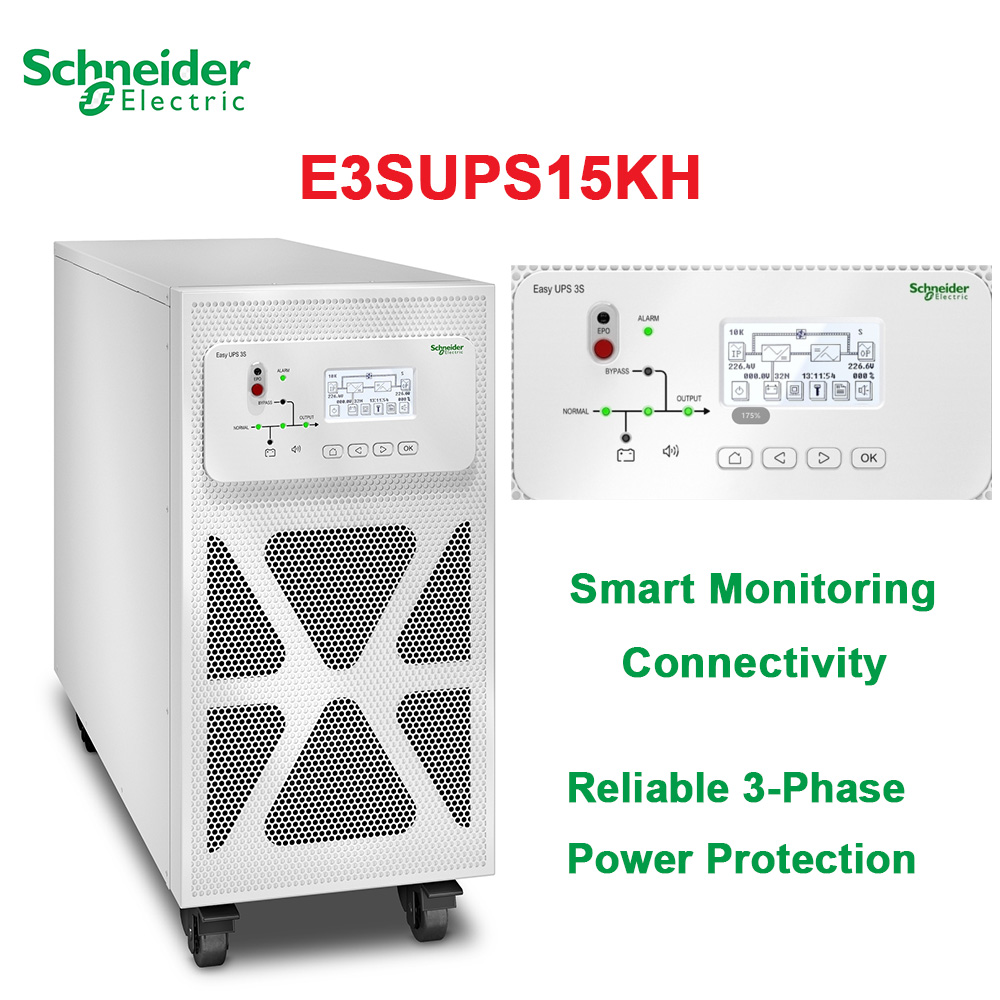
Online double-conversion UPS is currently the most widely used, most stable, and most versatile high-end UPS product in the industry. It is divided into two main branches: high-frequency and industrial frequency. High-frequency online UPS is the mainstream choice for small and medium-sized data centers and commercial and industrial scenarios. Its core working principle is double-conversion uninterrupted power supply. Regardless of whether the mains power is normal or not, the load equipment is powered by the inverter throughout the process: when the mains power is normal, the mains power is rectified into DC power, and then converted into standard AC power by the inverter to power the load, while charging the battery at the same time; when the mains power fails, the battery directly supplies DC power and the inverter inverts the output, with no switching delay throughout the process, truly achieving zero-interruption power supply.
Technical features: full-process dual-conversion architecture, zero switching delay, extremely high voltage and frequency stabilization accuracy, strong filtering and purification capabilities, and pure output waveform; high-frequency architecture with small size, light weight, fast response speed, and conversion efficiency of over 96%; high degree of intelligence, supporting remote monitoring, intelligent operation and maintenance, and multiple protections.
Advantages: Top-quality power supply, wide adaptability, energy-efficient, compact size, high level of intelligence, extremely low failure rate, and can cope with various complex power grid environments.
Disadvantages: Compared to power frequency equipment, it is slightly weaker in resisting impact loads and harsh environments, and is not suitable for extreme industrial and harsh scenarios.
Suitable for various scenarios: large, medium and small data centers, cloud computing centers, communication base stations, financial office systems, general medical diagnostic equipment, small and medium-sized industrial automation equipment, precision testing instruments and other high-precision and high-stability power supply scenarios, with power ranging from 1KVA to 200KVA, making it extremely versatile.