-
- APC Back UPS
- APC EASY UPS
- APC Modular UPS
- APC Smart SMC UPS
- APC Smart SMT UPS
- APC Smart SURT UPS
- APC SPM UPS
- APC Symmetra Power Module
- APC SYMMETRA LX
- APC Symmetra PX
- Eaton 5P UPS
- Eaton 5PX G2 UPS
- Eaton 93PR UPS
- Eaton 9PX Li-Ion UPS
- Eaton 9PX UPS
- Eaton 9SX Tower UPS
- Eaton DX RT UPS
- Eaton DX UPS
- Eaton Ellipse ECO UPS
- Eaton Marine UPS
- Eaton Power Module
- SANTAK UPS
- Schneider Galaxy 3L / EASY 3L UPS
- Schneider Galaxy VS UPS
- Schneider Galaxy VL UPS
- Vertiv UPS


Don’t understand data centers? This ultimate introductory guide is easy to understand even for beginners ( part 2)

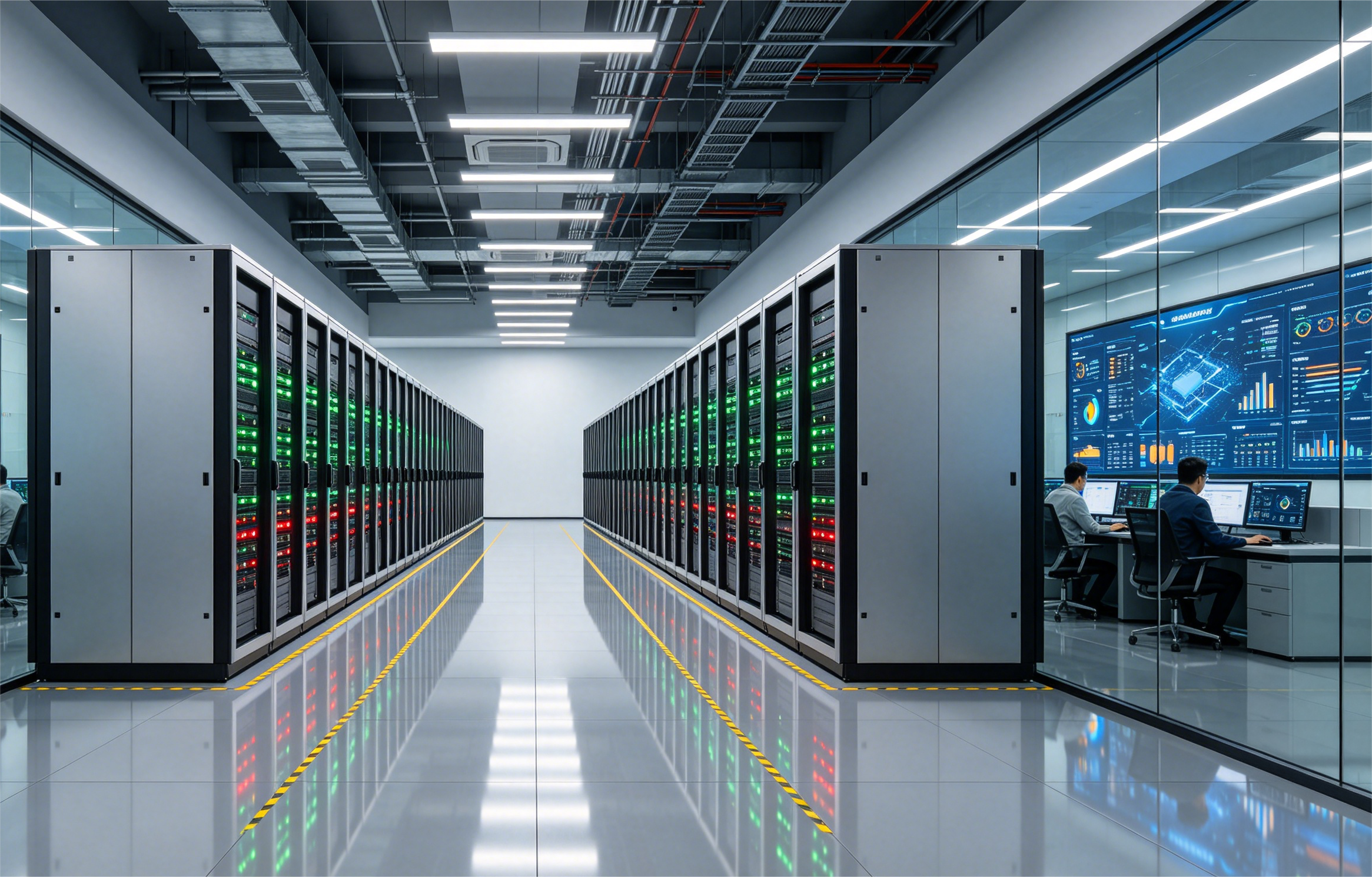
II. Composition and Structure of Data Centers
Next, let’s take a look at what components a data center actually consists of.
server equipment
The most basic equipment in a data center is, of course, the server. A server is essentially a high-performance computer, which most people have probably seen. It contains components similar to a desktop computer, such as a CPU, memory, motherboard, hard drive, graphics card (GPU), and power supply.
Previously, servers were primarily based on Intel architecture (and even earlier, PowerPC, SPARC, etc.). Now, with changes in national policy, domestically produced CPUs are rising in popularity and gaining an increasing market share. These domestically produced CPUs use the ARM architecture , offering better performance at a lower cost.
server rack
Servers are typically placed in racks (also called server cabinets). A common standard rack is usually 42U in height. U is a unit of measurement for the external dimensions of a server, an abbreviation for unit, and 1U equals 4.445cm. Rack widths are typically 600mm or 800mm.
Rack depths come in various sizes, including 600mm, 800mm, 900mm, 1000mm, and 1200mm. Generally speaking, IT equipment (server) racks are deeper (1100mm or 1200mm), while communication equipment racks are shallower (600mm).
storage devices
Big data is all the rage now, and the amount of data in data centers is increasing every year, which in turn increases the demand for storage devices in terms of both quantity and performance.
As we all know, the mainstream computer storage hard drives are now divided into two types: HDD and SSD. HDD is the traditional mechanical hard drive, while SSD is the solid-state drive that is gradually becoming more popular.
Communication equipment
Besides IT computing equipment, there are also data communication equipment such as switches, routers, and firewalls.
A switch is a network switching device at the lowest level of a data center, responsible for connecting servers within the rack and connecting to upper-level switches.
It’s worth noting that data centers now widely use fiber optic cables instead of network cables for high-bandwidth data transmission. Therefore, fiber optic cables, optical modules, and optical communication equipment (OTN, etc.) have become crucial components of data centers.
In particular, optical modules, especially high-speed optical modules (such as 400G), are very expensive and account for a large portion of the cost of data centers.
Power supply and distribution system
Power supply is fundamental to the normal operation of a data center. Without electricity, a data center is just scrap metal.
The main function of power distribution equipment in a data center is to control, switch on, and protect electrical power. The most important piece of power distribution equipment is the power distribution cabinet.
Data center power distribution cabinets are divided into medium-voltage and low-voltage cabinets. Medium-voltage cabinets are mainly 10kV, connected to the mains power supply and to the low-voltage cabinets. Low-voltage cabinets are mainly 400V, used for further conversion, distribution, control, protection, and monitoring of electrical energy.
In addition to power distribution cabinets, data centers are also equipped with a large number of UPS (uninterruptible power supplies) and even diesel generator sets to ensure normal power supply in emergencies.