-
- APC Back UPS
- APC EASY UPS
- APC Modular UPS
- APC Smart SMC UPS
- APC Smart SMT UPS
- APC Smart SURT UPS
- APC SPM UPS
- APC Symmetra Power Module
- APC SYMMETRA LX
- APC Symmetra PX
- Eaton 5P UPS
- Eaton 5PX G2 UPS
- Eaton 93PR UPS
- Eaton 9PX Li-Ion UPS
- Eaton 9PX UPS
- Eaton 9SX Tower UPS
- Eaton DX RT UPS
- Eaton DX UPS
- Eaton Ellipse ECO UPS
- Eaton Marine UPS
- Eaton Power Module
- SANTAK UPS
- Schneider Galaxy 3L / EASY 3L UPS
- Schneider Galaxy VS UPS
- Schneider Galaxy VL UPS
- Vertiv UPS


UPS is not just a “spare box” ( part 2)

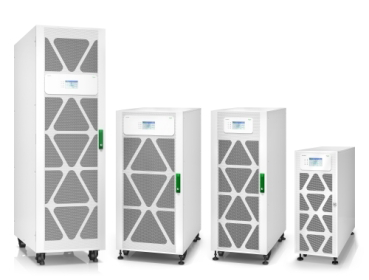
To avoid pitfalls when choosing a product, you must calculate these core parameters correctly. Don’t just ask “how many watts” right away, as this is the most common mistake.
a UPS are VA (apparent power) and W (active power), and their relationship is: W = VA × power factor . Common UPS power factors are between 0.8 and 0.9. Simply put, the minimum VA value you need for your UPS is the total power of all your devices divided by 0.8 . There’s also a golden rule of maintenance: never exceed 70% UPS load. Battery aging, future equipment expansion, and operational heat dissipation all require redundancy. Running at full load essentially shortens the UPS ‘s lifespan.
For a simple example: if your server and network equipment have a total power consumption of 3000W, assuming a power factor of 0.8, 3000 ÷ 0.8 = 3750VA. Therefore, a 5kVA UPS is the safest choice. It’s also important to correct a common misconception: many people believe that ” the larger the UPS , the longer the battery life,” which is not true. The UPS itself determines how many devices it can power, while the battery capacity determines the battery life. The core goal of a data center UPS is never unlimited power, but rather to provide sufficient time for a smooth transition: 15-30 minutes of backup power for network equipment, sufficient time for servers to shut down normally, and coordinated operation with generators in the core data center – this is sufficient.
III. Several Easily Overlooked Facts about UPS
Finally, let me share a few of the most easily overlooked yet fatal knowledge points in operations and maintenance, all of which are hard-earned lessons learned from trial and error.
First, bypass is not a lifeline, but the biggest risk. When a UPS fails, it will automatically switch to bypass, which means direct connection to the mains power. Once the bypass is activated, your equipment is completely exposed, and the power protection becomes zero.
Secondly, the battery is the core consumable of a UPS . The UPS main unit has a lifespan of 8-10 years , but the lifespan of a conventional lead-acid maintenance-free battery is only 3-5 years . A UPS that does not replace the battery on time is essentially just a decoration; it simply cannot withstand a power outage.
Third, temperature has a far greater impact on battery life than you might imagine. For every 10°C increase in ambient temperature, battery life is halved. It’s better to run the air conditioning in the battery room longer than to try to save a little on electricity bills and end up losing more than you gain.
Fourth, what UPS systems fear most is not their high price, but being “forgotten.” Many data centers install UPS systems and then neglect them, never performing discharge tests, only to regret it when the batteries bulge and power fails due to mains power outages.
Summarize
Remember these 6 key points, and you’ll be less likely to encounter problems when selecting and maintaining a UPS:
For server room UPS, online type is preferred; don’t skimp on capacity, but keep the load below 70%.
Battery life is not the same as the life of the main unit; UPS is for smooth transition, not for unlimited power.
Avoid using bypasses if possible; UPS is core infrastructure, not a dispensable decoration.
In data center operations and maintenance, details always determine success or failure.