



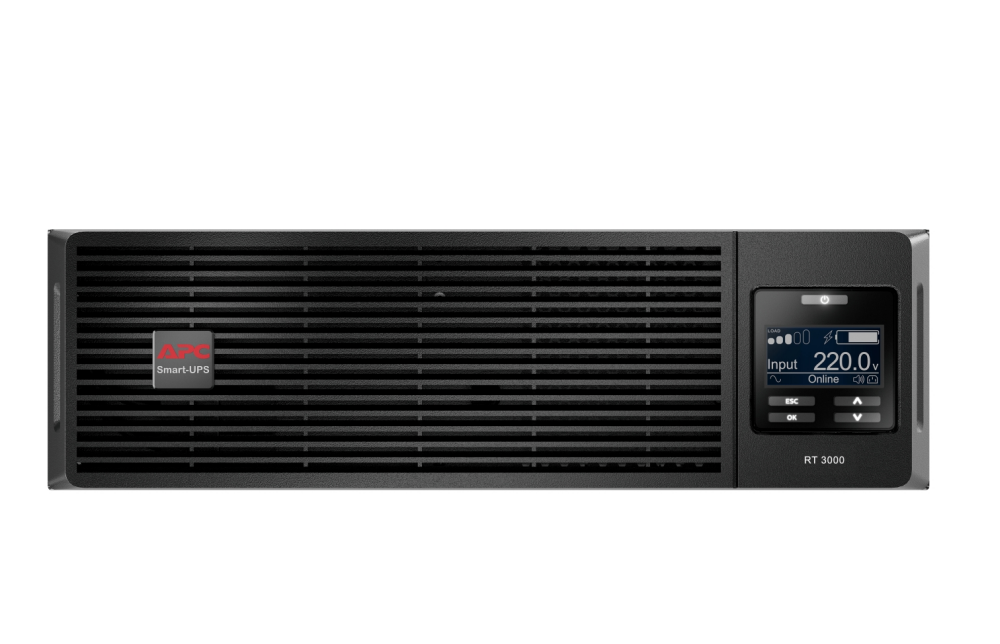
Backup UPS power supply, also known as BackUPS or Off line UPS in English, with the UPS battery inside the main unit, also known as standard machine/standard machine. Because the battery is inside the UPS host, the backup UPS uninterruptible power supply has a relatively short load time, usually a few minutes. When there is a power outage in the city, it usually takes a few milliseconds to switch to UPS battery power, so it is not recommended to choose a backup UPS for precision equipment.
Online UPS: also known as On line UPS, the UPS battery must be configured according to the power supply time.
Its main circuit architecture includes five types: surge absorption filtering circuit, alternating current to direct current circuit (AC/DC), direct current to alternating current circuit (DC/AC), microprocessor control circuit, bypass, etc.
Its action mode:
When the mains power is normal, it passes through a surge absorption filtering circuit → an AC to DC conversion circuit → a DC to AC conversion circuit → and converts AC power output to supply the load, while also charging the battery;
Once the microprocessor control circuit detects a power interruption, it immediately discharges the battery → converts DC power to AC power circuit → and converts AC power output to supply the load.
If the microprocessor control circuit detects a UPS fault, the UPS will use a relay (RELAY) to trip to the bypass (BYPASS), supply power to the load from the mains, and emit an audible warning to the user.
Online interactive UPS: also known as Line Interactive UPS. In circuit architecture, what is particularly special is the bidirectional inverter (BI-LATERALCONVERTER) and the automatic voltage regulation circuit (AVR: AUTOVOLTAGAEREGULATION)
Its function is that the bidirectional converter has two functions: charger (CHARGER) and inverter (DC/AC). The charger is similar to a fast charger, which can shorten the charging time from 7-8 hours to 2-4 hours to fully charge the battery. Therefore, its efficiency is higher than that of general chargers.
In the AVR section, there is a transformer with automatic boost (BOOST) and buck (BUCK) functions. When the microprocessor detects a low voltage, the AVR uses a relay to automatically switch to the boost coil, and vice versa, thereby achieving a more stable output voltage.
In principle, the main difference between backup UPS and online UPS is that backup UPS only stabilizes the mains power when there is mains power, and the inverter does not work and is in a waiting state. When the mains power is abnormal, the backup UPS will quickly switch to the inverter state, converting the battery power into AC power to continue supplying power to the load. Therefore, backup UPS will have a transition time from mains power to reverse operation, generally less than 10ms.
After the online UPS is turned on, the inverter is always in working condition, so there is no interruption time when the mains power is abnormally converted to battery discharge, that is, zero interruption. Online interactive UPS refers to the inverter of the UPS working in reverse to charge the battery when the input mains power is normal. When the mains power is abnormal, the inverter immediately starts to invert and convert the battery pack voltage into AC power output. Therefore, online interactive UPS also has conversion time.