-
- APC Back UPS
- APC EASY UPS
- APC Modular UPS
- APC Smart SMC UPS
- APC Smart SMT UPS
- APC Smart SURT UPS
- APC SPM UPS
- APC Symmetra Power Module
- APC SYMMETRA LX
- APC Symmetra PX
- Eaton 5P UPS
- Eaton 5PX G2 UPS
- Eaton 93PR UPS
- Eaton 9PX Li-Ion UPS
- Eaton 9PX UPS
- Eaton 9SX Tower UPS
- Eaton DX RT UPS
- Eaton DX UPS
- Eaton Ellipse ECO UPS
- Eaton Marine UPS
- Eaton Power Module
- SANTAK UPS
- Schneider Galaxy 3L / EASY 3L UPS
- Schneider Galaxy VS UPS
- Schneider Galaxy VL UPS
- Vertiv UPS


Don’t understand data centers? This ultimate introductory guide is easy to understand even for beginners ( part 4)

III. Types of Data Center Services
Basic hosting services
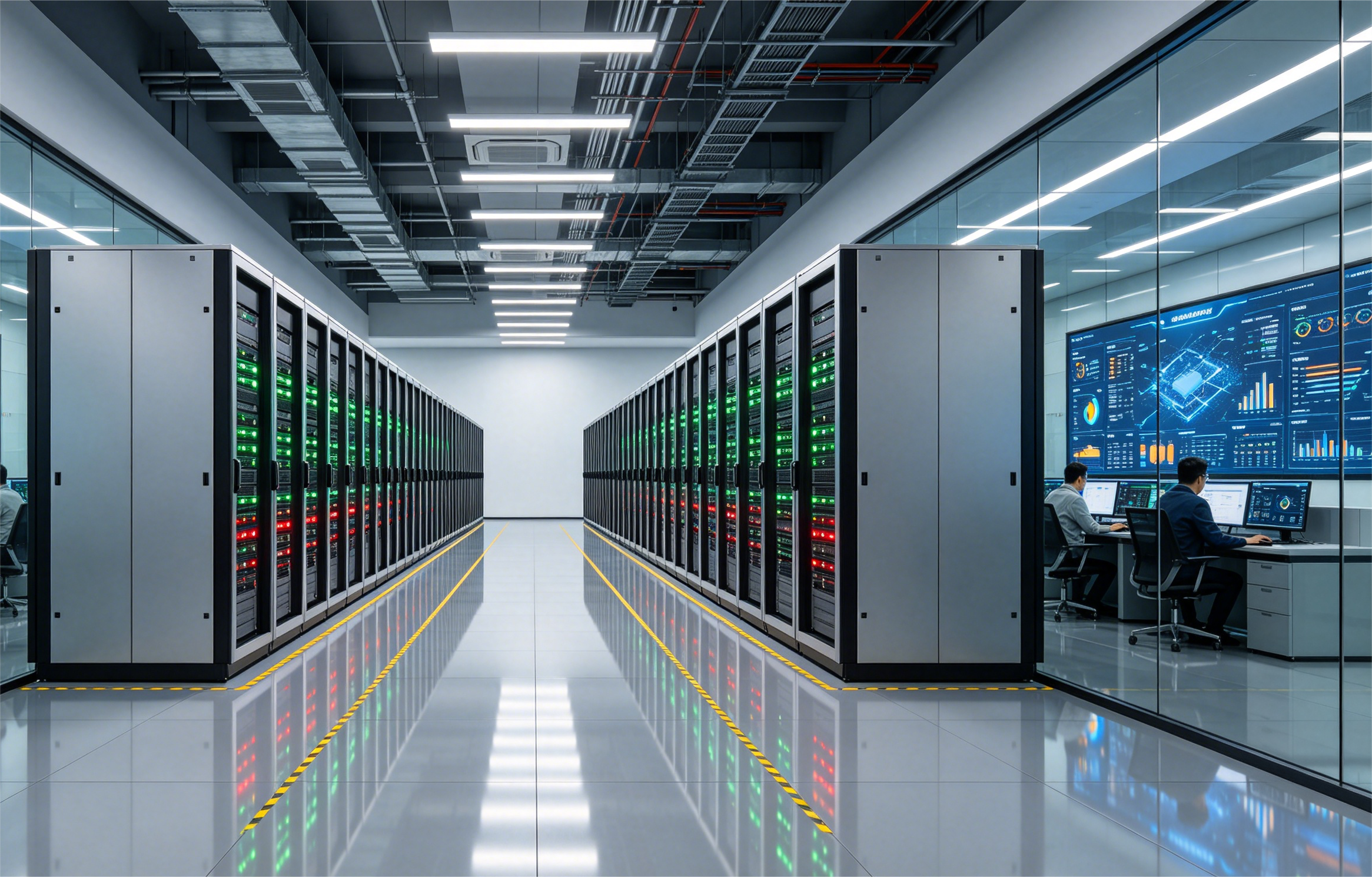
This type of business is the “cornerstone” of data centers, providing customers with racks or entire cabinets to house their own servers, storage devices, network equipment, etc., while also providing services such as continuous power supply, constant temperature cooling, and physical security protection.
For example, Maidechuang Technology hosted the core database server of a cross-border e-commerce company in Chengdu to the Ya’an Chuanxi Big Data Data Center, avoiding the high costs of building its own data center (electricity, cooling, operation and maintenance) while enjoying a T3+ level data center environment.
Bandwidth and network access services
We provide high-speed internet bandwidth (such as 100M/1G/10G dedicated bandwidth), IP address leasing (fixed IP, IPv6 address), and multi-line redundant access (such as China Telecom, China Unicom, and China Mobile combined) to ensure that the customer’s network has “no single point of failure”.
Emerging core businesses
With the development of cloud computing, AI, and big data, data centers are transforming from “hardware hosting providers” to “computing power and intelligent service providers,” and this type of business is currently the fastest growing segment.
1. Cloud computing and hybrid cloud services
Managed Private Cloud: We build dedicated private clouds for our clients, deployed within data centers, balancing the security of the private cloud with the stability of the data center.
Public Cloud Integration: As a partner of mainstream cloud vendors (such as Alibaba Cloud and Huawei Cloud), we provide a hybrid cloud architecture of “public cloud resource hosting + local data center” to solve customers’ needs for “local storage of core data + on-demand access to elastic computing power”.
2. AI Computing Power Services
Computing power leasing: Providing GPU clusters, such as NVIDIA A100 and H100, to support high-density computing scenarios such as large model training, autonomous driving data processing, and scientific computing.
Computing power scheduling and optimization: Enable on-demand allocation of computing power through software platforms (such as time-sharing leasing and billing based on computing power usage), and provide computing power monitoring and energy consumption optimization services to reduce the computing power costs of customers’ AI businesses.
3. Edge computing node services
For low-latency scenarios such as the Internet of Things, autonomous driving, and live streaming, small data centers are deployed on the edge of cities to provide localized data processing and caching services, reducing network latency from “milliseconds” to “microseconds”.
Summarize
Driven by the “Eastern Data, Western Computing” strategy, domestic data centers are experiencing another wave of development. In addition to a surge in numbers, data centers are moving towards green and intelligent technologies, actively introducing AI to improve energy efficiency and reduce operational complexity.